
The LinkedIn Loop No One Warned Me About
The hardest part isn’t posting. It’s knowing which metric matters.

#022
The Sales Promise That Sends Founders in Circles
LinkedIn is sold to as the ultimate sales machine. Optimise your profile, send the right message, and watch your inbox fill with leads.
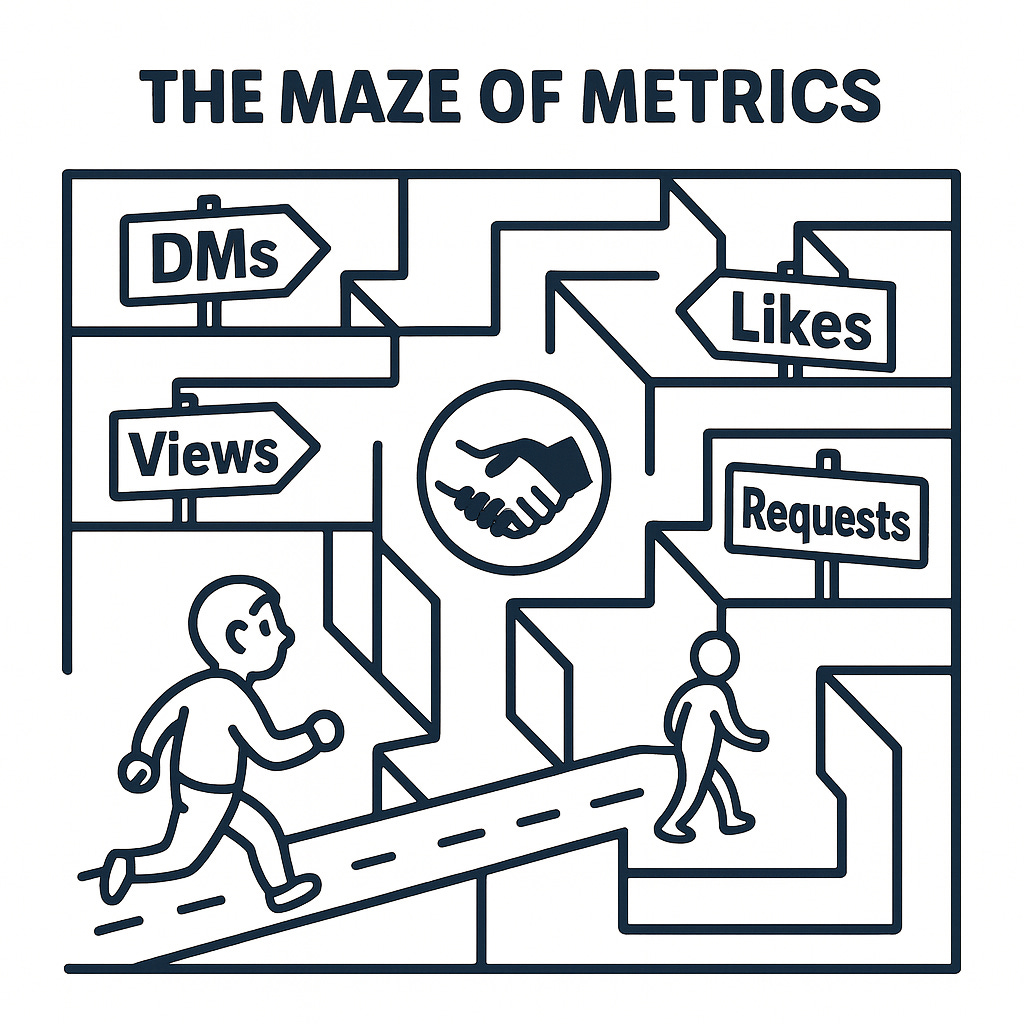
It’s not hard to see why. LinkedIn drives up to 80% of B2B social media leads, so the promise feels real. But that’s also what drags many of us into the wrong chase. We start treating every number as proof we’re closer to a deal. Profile views. Likes. Connection requests. Even the occasional DM that never leads anywhere.
They look like signals of progress. And in some ways, they are. They show you’re active, they show something is moving. But if you stop there, you end up mistaking surface activity for real traction.
The Quick-Win Pitch
When the signals stall, the other extreme shows up. The quick-win sales playbook.
You’ve probably seen it. Optimise your profile, dangle a freebie, follow a script, and fill your calendar. The promise is clean and convincing because it skips the hard part. It makes traction sound like a hack, something you flip on with the right words in the right message.
I’ve tested versions of this too. And while it can generate replies, it rarely generates belief. You might land a call, but it doesn’t build anything that lasts.
That’s not just my experience. LinkedIn explicitly bans most automation tools, and audiences spot gimmicks instantly. As one expert put it, “Focus on leads, not likes.” If a script gets attention but doesn’t build trust, you’ve only gained noise.
My Own Loop
On LinkedIn, I started to see signs of life. Posts that used to go nowhere picked up a few likes. Sometimes a comment. A notification would pop up, someone viewed my profile. I would check, hoping it was a founder in my niche. Most times, it wasn’t.
It felt good to see activity. But after weeks of posting, the conversations I wanted still weren’t happening. I was putting in effort, but I wasn’t moving closer to the right people.
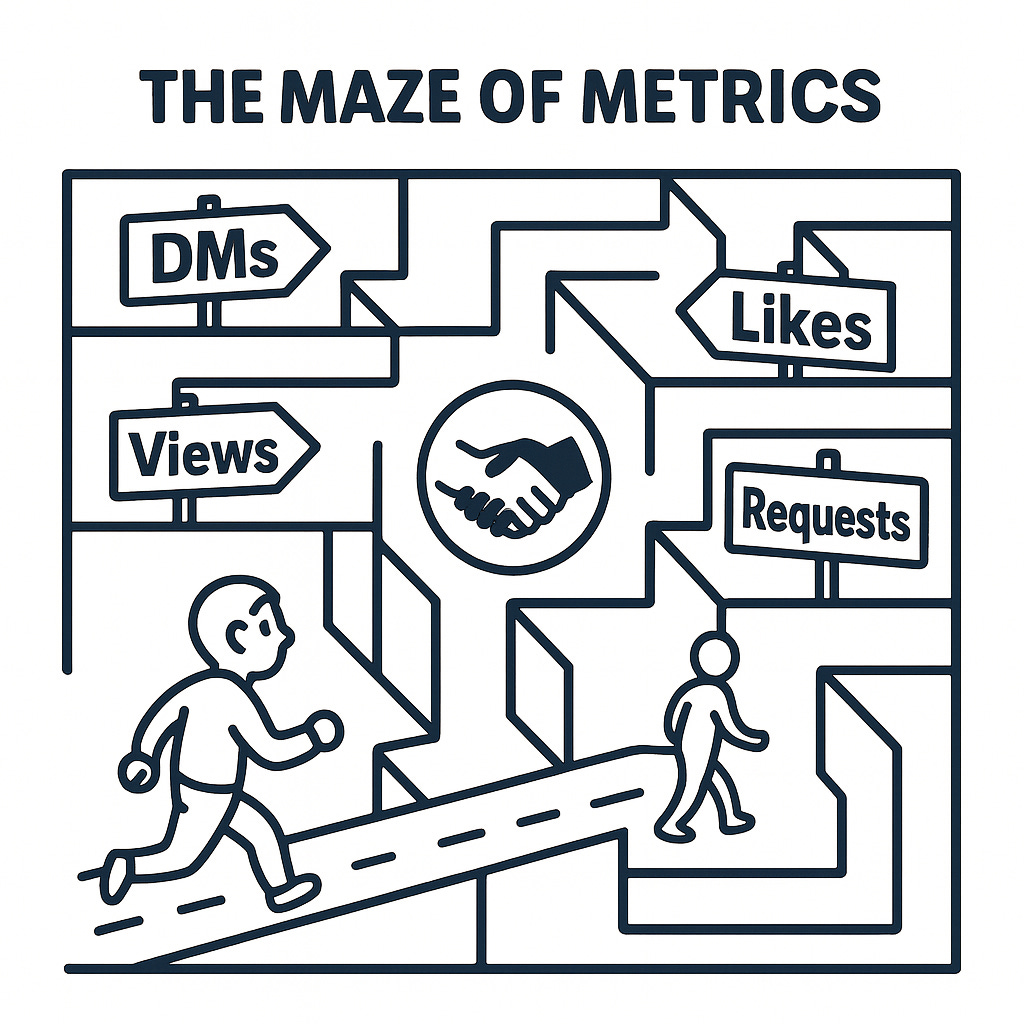
That’s when I realised I was stuck in a loop. Encouraging signals on the surface, but nothing that shifted the ground under me.
This is common. Audience growth usually follows an exponential curve. Nothing much happens at first, then suddenly things start compounding. That flat early stage makes it easy to cling to any signal, even when it doesn’t mean much.
It felt like I was running on the spot. Proof I wasn’t invisible, but also proof that being seen and being believed aren’t the same thing
.
The Hard but Truer Path
What sits between empty signals and empty scripts is a slower path that actually compounds.
It’s when people don’t just see you, they start to take you seriously. When the right conversations begin to open because there’s proof in how you show up, not just in what you pitch.
Founders who succeed on LinkedIn stress the same thing. Growth comes from delivering the right content to the right people over time. Not virality or hacks. Just steady proof of who you are and how you think.
That’s what sticks. That’s what eventually moves deals forward.
What I’m Testing Instead
When the quick-win scripts didn’t stick and the likes stopped feeling like progress, I started trying different things:
Counting differently. My likes went from single digits to double digits. That looked good on the surface, but it forced me to ask, do these reactions come from people who can actually move my work forward?
Reaching out. I DMed based on profiles. Most replies were polite “no’s.” I paused, but it showed me that progress isn’t about avoiding rejection. It’s about collecting enough of them until the yeses appear.
Writing with harder filters. I started prompting myself differently. Would the top 0.01% expert in this field respect this post? What if two opposing experts debated it, would my argument hold? These filters don’t guarantee traction, but they push me closer to trust than a polished one-liner ever could.
Borrowing depth. Substack keeps me honest. Writing long form there, with feedback from the community I joined, forces me to clarify my thinking. Then LinkedIn becomes the test ground where I distribute those ideas in smaller bites.
I don’t have a playbook yet. Just experiments. But even in this trial-and-error, I can feel the difference between surface activity and signals that actually matter.
The Real Test of Progress
I never thought LinkedIn sales would be easy. Serving clients outside my time zone and cultural environment means there’s a lot I need to learn, about outreach, about trust, about how conversations even begin.
So the work isn’t about chasing more likes or forcing more DMs onto my calendar. It’s about learning to recognise the signals that actually move things forward. The ones that are quieter but sharper, a saved post, a question in the comments, a follow-up that turns into a real conversation.
The hard part isn’t showing up. It’s learning which signals matter and which ones just keep you circling.
Enjoyed reading this? Got any ideas or tips for me? Got a question you’d like to ask?
I want to be a lot more interactive going forwad, so I would love to here from you. Send me a message.🖤
It’s easy to chase vanity metrics like profile views and likes when what really matters is whether the right people are starting to trust you. I’ve found the same thing in my work: real traction comes from consistency and depth, not quick-hit engagement. Your point about 'counting differently' is exactly right; it’s not about volume, it’s about signal.
What you’ve shared is very consistent with my experience…lots of likes and comments (usually from other writers and consultants!) doesn’t always translate into real inquiries and sales.